
Fast Fossilization
All those words will be lost in time, like tears in the rain.

A fossil word is defined as a word that is broadly obsolete but remains in current use due to its presence within an idiom or phrase” [Wiki]:
amok, as in "run amok"
shebang, as in "the whole shebang"
jetsam, as in "flotsam and jetsam"
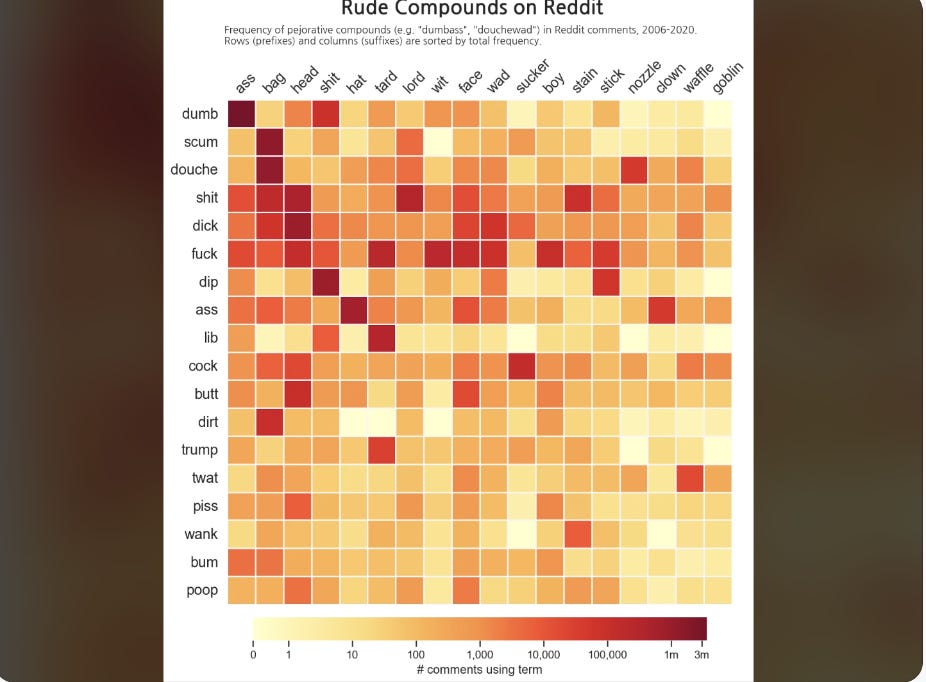
These words have died out through years of gradual linguistic palimpsest, ushered out of our vocabulary like a nonagenarian Politburo member who’s finally forgotten where the Kremlin’s loos are. But what happens when this process occurs not once – but two, three, a hundred times a year? Take a look at this grid that illustrates the use of compound swear words in Reddit forums — and the frequency with which new terms were (and are) being created in these spaces.
Following that scatalological tangent, in 2023, Cory Doctorow coined the word “enshittification” to capture TikTok’s slow decline as a user-first platform. It quickly captured the digital imagination and, quite literally, enshittified articles everywhere. Some things we’ve witnessed the enshittification of, according to the internet:
the Internet
Fast casual fare (see - Chipotle Mexican Grill)
Local news
Pixar Animation
Large language models
Manchester United
Whether you agree with Doctorow’s sentiment or not, there’s no doubt that his aphorism was pounced upon with vampiric ferocity, in part because of its ability to capture an all-together chaotic and complex digital zeitgeist. In an article in Feb 2023, Nancy Friedman predicted it’s success:
“As an element of company and product names, the –ify suffix has been astonishingly— even ludicrously—successful. Beginning around 2008, when the audio-streaming site Spotify was founded, hundreds of brand names have followed the –ify formula: Abilify (the depression drug), Expensify (accounting software), Shopify (e-commerce platform), Forgotify[...] It is a naming fad gone amok.”[...]
All of which is to say that enshittify and enshittification are primed for neologistic success.”
The buzzword lived up to its name: by January 2024 it had been selected as 2023’s word of the year [ref]. But Doctorow’s semantic Pokémon ball was actually the apotheosis of a wider trend that had been bubbling in the background…
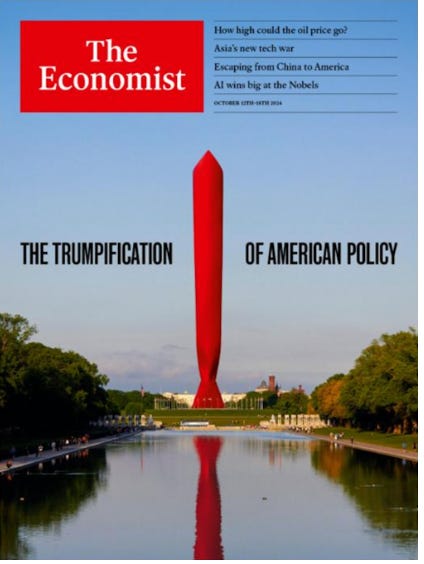
In the five year period (roughly) before enshittification was unleashed on the world, the suffix “-tion” had already been enjoying considerable popularity online. Its rapid uptake was partly a response to the nifty ring-fencing that words like Doctorow’s achieves, as expertly broken down by Lauren Michele Jackson in her 2023 New Yorker article:
“Nominalizations are not something that most of us spend any time thinking about. We repeat the ones we’ve heard or read, making use of them intuitively. We tend to reach for them, in particular, on occasions when we want to demonstrate expertise. Compared with other, “concrete” nouns that follow the usual “person, place, or thing” [...] nominalizations usually convey abstract concepts: “establishment,” “divinity,” “happiness.”
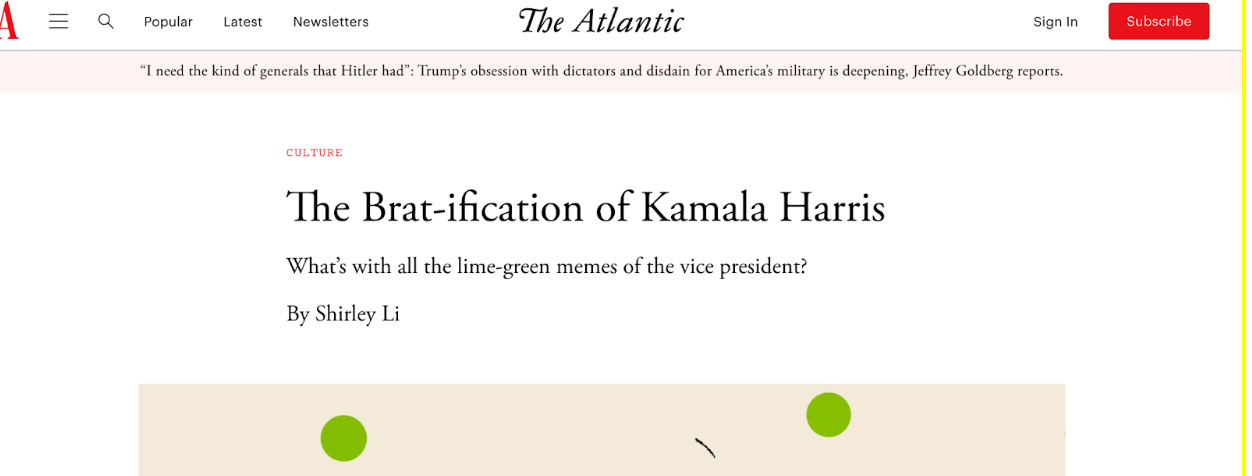
In a world where micro-trends and cultural moments have a lifespan that is exponentially shorter, this process of labeling allows us to digest the intricacies of internet phenomena far easier (and far faster). Like TikTok’s sound bites, we are being primed for the digestion of the new. At a semantic level, it is a more identifiable colloquialism. Even if we may not fully grasp the thesis of Doctorow’s criticism, enshittify’s wordplay resonates with us, allowing us to laugh along at a joke we may not entirely understand:
“On the one hand, the words grasp for the precision required to keep up with the swiftly tilting present. On the other, they risk impeding understanding rather than facilitating it.” [Jackson again]
More than that, though, it gives us meaning in a world where more often than not…there is none. Perhaps the suffix was latched onto because grammatically it presupposes a creator or driving force, specifically human, behind these trends. In a world where virality is random and unpredictable, it is reassuring to label these things as part of some wider machination, as stemming from some sort of human design or demand.
But this accelerated -ification also raises a more important question that Jackson hints at in her mention of the ‘swiftly tilting present’ – just as quickly as language is born, how fast, in the digital age, is it dying out? Enshittification’s headliner moment seems to have lost its sheen; one wonders how relevant many of the offshoots are today. As Jackson points out:
Many of the “-ification” source words are proper nouns, in particular—Trump, Kim Kardashian, Goop—but their nominalization refers not to the specific people or brands so much as to whatever values they represent.
Taking this a step further, they don’t simply espouse the values of a Trump or a Kardashian or Goop - they espouse their values at that given moment in digital space-time. They are inextricable from the cultural context of their conception; the Trumpification of 2023 will likely mean something quite different to the Trumpification of 2024.
If the internet birthed a new age of slang, the rise to prominence of platforms like Reddit and Twitter has paved the way for a fresh boom in contemporary lexicons, enabling trends like -ification to snowball. But like many things born out of online popularity, their lifespan can be short. Each year, the Oxford Dictionary’s new additions are composed more by internet slang terms than they are anything else. The rapid advance and adoption of AI tools also posits the possibility of new semantic horizons. And yet, additions to the OED like “Derp”, “Whatevs” and “chillax” all seem like a (thankfully) distant Millennial fever dream. One wonders about the shelf-life of these new words.
The most recent example might be Charli XCX’s “Brat”, which Collins Dictionary just declared the 2024 word of the year. Originally a marketing ploy to accompany the studio album she released of the same name, it has exploded across the internet to the point of almost unavoidable occurrence. And yet, it seems unlikely that something tied to such a specific cultural moment will entirely outlive its “moment”. More likely, it will fade into obscurity, its meaning forgotten somewhere in the dusty annals of the internet, a fossil to be dug up on occasion with a twinge of nostalgia.
In the process of fossilization, the more minerals there are in the soil, the faster it takes place. If words are the minerals in our linguistic dirt, then fossils are soon to be in abundance, condemned to sit for eternity somewhere on the internet. The break-neck rate at which our digital melting pot is spewing out new forms is, at the same time, crystallizing them all the quicker. The words of last year already seem frozen over, dinosaurs now in the accelerated temporality of the internet.
Pessimists might paint a picture of a future plagued by overconsumption and hyper-obsolescence; a long and weary and befuddling trudge through layer upon layer of silty, permineralized graveyards. A place where meaning is lost as quickly as it is created. But a mineral-rich soil is also one that is fertile, and the messiness of digispeak is rife with a creativity that we would do well to nurture. I, for one, can’t help but feel that a future in which the notion of a “dickgoblin” can exist, is indeed a bright one.
So so incredibly brilliant!!!
Such a thoroughly enjoyable read. Thank you so much; you write with such verve and polish and yet so much levity too.